Sunday, December 16, 2018

Lesson 12

PASSOVER FEAST 

Reading : Exo. 12, Lev 23:5, Deut 16: 1-8
Memory verses : 1 Cor 5: 7,8


Theme: To live fellowship with God after being saved from condemnation and slavery of sin through the death and resurrection of Jesus Christ, Our Passover Lamb.

Introduction: Who was the leader whom God used to liberate Israel from slavery in Egypt? How many plagues were sent to the Egyptians? Which was the last plague? How were the Israelites to escape from the last plague? What was the name given to the lamb that was killed at that time? They started their journey from Egypt to Canaan in that night. Passover was instituted to commemorate that day every year on the 14th of first month.


Related image


Beginning of Passover. Moses was sent by God to Egypt to deliver Israel from Egypt. Moses asked Pharaoh to let the people leave Egypt. But Pharaoh refused. Nine plague were sent on the Egyptians one after the other. Pharaoh was still adamant. Lastly, the last plague of killing the first born of Egypt was declared. But God commanded Israel to observe Passover to escape from that plague.

The head of the Israelite family was asked to set apart a blemish-less lamb on the 10th day of the first month. The lamb was to be killed in the evening of the 14th day Blood of the lamb must be put on the two side posts and on the upper door post of the house. Its flesh, roasted in fire must be eaten that night together with unleavened bread and bitter herbs. The bones of the lamb should not be broken. It must be eaten in haste, with their loins girded, shoes on their feet and staff in their hand signifying readiness to start their journey.

The first Passover was thus observed in Egypt. The angle of destruction came down that night and killed all the firstborns of Egypt. The sign of blood on the door posts of Israel saved them from destruction. The Egyptians compelled Israel to leave Egypt that night. A large group of people numbering six hundred thousand of men and their women and children set out on foot from Egypt. 

Yearly Observance:


Israel were commanded to observe the Passover feast every year on the 14th day of first month.

On the fourteenth day of the first month at twilight is the Lord's Passover.(Leviticus 23:5)

It can be seen from history that they continued to celebrate the feast as they were command. It was being celebrated even at the time of our Lord Jesus Christ. Christ was crucified during a Passover festival. 

Now the Passover of the Jews was at hand, and Jesus went up to Jerusalem. 14 And He found in the temple those who sold oxen and sheep and doves, and the moneychangers doing business. (John 2: 13, 14) 

Meaning of the word 'Passover': Leteral meaning of the word is : to pass over. 


For I will pass through the land of Egypt on that night, and will strike all the firstborn in the land of Egypt, both man and beast; and against all the gods of Egypt I will execute judgment: I am the Lord.(Exodus 12:23)

The name points to the night when the angle of destruction pass over the Israeli houses by seeing the sign of blood at he door posts.

SPIRITUAL TRUTHS AS REVEALED BY PASSOVER

1. Lamb of God: The chief objects in 'Passover' is the lamb. 
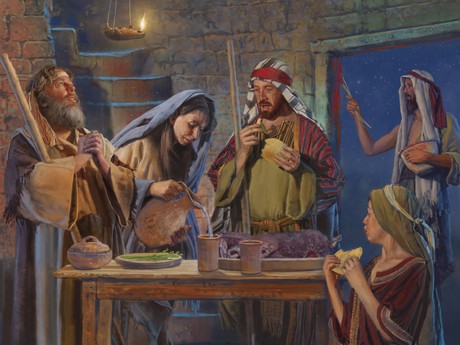

Image result for passover meal


The lamb foreshadows Jesus Christ.

Therefore purge out the old leaven, that you may be a new lump, since you truly are unleavened. For indeed Christ, our Passover, was sacrificed for us.(1 Corinthians 5: 7)

Christ is called Lamb in the scripture. The lamb is set apart four days before the Passover. Our Lord Jesus Christ was set apart as the Lamb of God before the foundation of the world. In the fullness of time the was crucified.

All who dwell on the earth will worship him, whose names have not been written in the Book of Life of the Lamb slain from the foundation of the world.(Revelation 13:8)


Just as the Passover lamb was burned in fire, Christ suffered in the fire of the wrath of God. The command the bones of the Lamb should not be broken was also fulfilled in Jesus Christ. His legs were not broken although the legs of the other two on the cross were broken. " Even Christ out Passover Lamb is sacrificed for us" Thus we are delivered from death which is the wages of out sin and from the bondage of Satan.


2. The Liberated Israel : People of Israel who were delivered from the bondage of Egypt be the blood of the Passover Lamb stand for New Testament believers. Our salvation is only through the blood of Jesus Christ. There is no condemnation for those who believe in him. Just as Passover marked the beginning of the year of Israel, faith in the sacrificial death of Jesus Christ opens a new chapter in out lives. Putting blood at the door posts shows that we are taking refuge in Him be faith. Eating of the roasted meat points towards the need to know Christ deeply and experience Him on our lives. It also signifies the participation of God's people in the Lord's Table. Believers must grow in strength through the partaking of Christ.

3. Unleavened Bread: Leaven represents uncleanness. Believers must keep holiness in life and doctrines. God commands: Do not touch any unclean things.


4. Bitter herb: when we are part of Christ, there will be experiences of bitterness and sorrows in this world. Jesus warned His disciples: " In the world you shall have Tribulation: but be of good cheer" (John 16:30). Apostles exhorted delivers we must go through much tribulation enter into the kingdom of God.


 strengthening the souls of the disciples, exhorting them to continue in the faith, and saying, "We must through many tribulations enter the kingdom of God." (Acts 14:22)

5. Eating the Passover meal in haste with loins girded, shoes on feet and staff on hand: believers must be ready to do service as per the example shown by our Lord. Our feet must have the preparation for the Gospel, of peace. Like Abraham we must consider out selves as strangers and pilgrims looking for the heavenly city. Let us always remember that we are journeying from this land of destruction to the city of Zion.

6. The Passover meal should not be eaten by a stranger: Only the saved ones have fellowship with God and His Church.

Are you saved by the blood of the Lamb of God? Do you have constant fellowship with Jesus Christ and the Church of God?


Lesson 11

FESTIVALS OF JEHOVAH 

Related image

Reading: Lev 23

Memory verses: 2 Cor. 2: 14, Pas. 118:15

Theme: To celebrate the victory and joy of life in Jesus Christ

Introduction: Is Christian life joyful or sorrowful? What is your personal opinion? Do the people whom you know praise God and rejoice in all circumstances of their life? Paul and Silas sang praises to God in the prison of Philippi

 But at midnight Paul and Silas were praying and singing hymns to God, and the prisoners were listening to them.(Acts 16:25)


Paul asks the Philippians to rejoice in the Lord always when the writes to them from the prison of Rome.

Rejoice in the Lord always. Again I will say, rejoice! (Phil 4:4)

The voice of rejoicing and victory will be in the tabernacles of God's people. Festivals if Israel are shadows of this truth. As these are given to Israel by God Himself the festivals are called the Festivals of Jehovah.

REASONS FOR GIVING THE FESTIVALS OF ISRAEL


1. It was the will of God that people who were delivered from Egypt should enjoy not only peace and rest but also happiness and joy in their life.

 You shall rejoice before the Lord your God, you and your son and your daughter, your male servant and your female servant, the Levite who is within your gates, the stranger and the fatherless and the widow who are among you, at the place where the Lord your God chooses to make His name abide. 12 And you shall remember that you were a slave in Egypt, and you shall be careful to observe these statutes. (Deuteronomy 16:11,12)

But their joy should be in the presence of God. Therefore, festivals were instituted by God to give them spiritual, happiness and sustain them in that happiness. New Testament believers also must rejoice in the Lord always.

2. It was the practice in Israel to hear the Word of God during the festival. People gathered together on the first day of the seventh month at the time of Nehemiah. Ezra stood up on a platform and read the law to the people from morning till noon. They rejoiced hearing the Law. It is an experience of joy to read, hear and meditate on the word of God.

Related image

 Now all the people gathered together as one man in the open square that was in front of the Water Gate; and they told Ezra the scribe to bring the Book of the Law of Moses, which the Lord had commanded Israel. 2 So Ezra the priest brought the Law before the assembly of men and women and all who could hear with understanding on the first day of the seventh month. 3 Then he read from it in the open square that was in front of the Water Gate from morning until midday, before the men and women and those who could understand; and the ears of all the people were attentive to the Book of the Law. 4 So Ezra the scribe stood on a platform of wood which they had made for the purpose; and beside him, at his right hand, stood Mattithiah, Shema, Anaiah, Urijah, Hilkiah, and Maaseiah; and at his left hand Pedaiah, Mishael, Malchijah, Hashum, Hashbadana, Zechariah, and Meshullam. 5 And Ezra opened the book in the sight of all the people, for he was standing above all the people; and when he opened it, all the people stood up. 6 And Ezra blessed the Lord, the great God. Then all the people answered, "Amen, Amen!" while lifting up their hands. And they bowed their heads and worshiped the Lord with their faces to the ground. 7 Also Jeshua, Bani, Sherebiah, Jamin, Akkub, Shabbethai, Hodijah, Maaseiah, Kelita, Azariah, Jozabad, Hanan, Pelaiah, and the Levites, helped the people to understand the Law; and the people stood in their place. 8 So they read distinctly from the book, in the Law of God; and they gave the sense, and helped them to understand the reading. (Nehamaiah 8:1-12)


3. Gathering of people from different places at one location during the festivals was providing opportunities to know each other and enjoy loving fellowship. In those days when communications were difficult, festivals helped people to remain as nation. Believers should endeavor to help each other and be in fellowship. Forget not to do good and to communicate.

But do not forget to do good and to share, for with such sacrifices God is well pleased.(Hebrew 13:6)

4. Festivals served as a reminder to other nations about the strength of Israel and prevented attack on them. Enemies of the gospel will be afraid if believers stand together. The Lord wants His people to be perfect in unity.

Now I am no longer in the world, but these are in the world, and I come to You. Holy Father, keep through Your name those whom You have given Me, that they may be one as We are. (John 17:11)


5. Festivals were occasions for people to bring their tithes offerings and voluntary donations to the Temple of God. New Testament believers are duty bound to give bountifully for Lord's work from their material blessings.

But this I say: He who sows sparingly will also reap sparingly, and he who sows bountifully will also reap bountifully. 7 So let each one give as he purposes in his heart, not grudgingly or of necessity; for God loves a cheerful giver.( 2. Cor.9:6,7)


6. Festivals of Israel prevented them from observing festivals of the heathen. They were commanded to observe separation and holiness as God's special people. Believers must keep themselves separated from heathen festivals and find joy in the presence of God along with other believers.

7. Festivals contained great prophetic meanings. They foreshadowed Christ's death and resurrection. His second coming, the millennium etc. In the New Testament age, we have to experience the substance of the festivals. How foolish it will be if we still run after the shadow!

Hebrew months: Days were allotted for the celebration of the festivals. The month in which they were liberated from Egypt was the first month in their calendar. Let us learn the Hebrew months in their order.


1. Abib (Nisan)  - Esther 3:7

2. Ziv   - 1 king 6:1

3. Sivan  - Esther 8:9

4. Thammuz - Ezekiel 8:14

5. Ab   - Ezra 7:9

6. Elul -  Nehemiah 6:15

7. Ethanim  (Tissri) - 1 king 8:2

8.Bul (Marchesvan) -  1 King 6:38


9. Chislev - Zachariah 7:1

10. Tebeth -  Esther 2:16

11. Shebath - Zachariah 1:7

12. Adar - Esther 8:11


Seven festivals God had given Israel seven festivals. All males in Israel were commanded to gather together in the presence of God on three seasons of the year and celebrate the festivals.


 "Three times you shall keep a feast to Me in the year 15 You shall keep the Feast of Unleavened Bread (you shall eat unleavened bread seven days, as I commanded you, at the time appointed in the month of Abib, for in it you came out of Egypt; none shall appear before Me empty); 16 and the Feast of Harvest, the firstfruits of your labors which you have sown in the field; and the Feast of Ingathering at the end of the year, when you have gathered in the fruit of your labors from the field. 17 Three times in the year all your males shall appear before the Lord God.(Exodus 23: 14 -17)


1. Passover                             : Month 1 Day 14

2. Unleavened bread              : Month 1 Day 15 - 21

3. First fruits                          : Month 1 Day 16

4. Pentecost (feast of weeks) : Month 3 Day 6

5. Trumpets                           : Month 7  Day 1

6. Atonement                         : Month 7 Day 10

7. Tabernacles                        : Month 7 Day 15 - 22   


The three festivals in the first month are referred to as Passover feast or the fest of the unleavened bread. As the fourth festival falls on the fiftieth day after the festival of the first fruits, it is known as the feast of Pentecost or the festival of the weeks. The three festivals falling in the seventh month are together known as the fest of the tabernacles.

OTHER FESTIVALS OF ISRAEL

Two more festivals were added in Israelite calendar later on.

1. Feast of the dedication :

 Now it was the Feast of Dedication in Jerusalem, and it was winter. (John 10:22)

Antiochus Ephiphanus, the Syrian king desecrated the Temple of Jerusalem by sacrificing a pig in it. Temple was reclaimed by Maccabees and dedicated once again. To commemorate this event, Israel started to observe on the feast of dedication on the 25th day to the 8th month from B.C 164. On that day Jewish homes would be illuminated and the heroic deeds of the Maccabees would be narrated to their children.


2. Festival of Purim:

And Mordecai wrote these things and sent letters to all the Jews, near and far, who were in all the provinces of King Ahasuerus, 21 to establish among them that they should celebrate yearly the fourteenth and fifteenth days of the month of Adar, 22 as the days on which the Jews had rest from their enemies, as the month which was turned from sorrow to joy for them, and from mourning to a holiday; that they should make them days of feasting and joy, of sending presents to one another and gifts to the poor. 23 So the Jews accepted the custom which they had begun, as Mordecai had written to them, 24 because Haman, the son of Hammedatha the Agagite, the enemy of all the Jews, had plotted against the Jews to annihilate them, and had cast Pur (that is, the lot), to consume them and destroy them; 25 but when Esther came before the king, he commanded by letter that this wicked plot which Haman had devised against the Jews should return on his own head, and that he and his sons should be hanged on the gallows. 26 So they called these days Purim, after the name Pur. Therefore, because of all the words of this letter, what they had seen concerning this matter, and what had happened to them, (Esther 9:20-25)


When Haman, the minister of king Ahasuerus plotted to annihilate the Jewish race, they were saved miraculously by God's providence. Thus Purim was declared as days of joy and victory on 14th and 15th Adar (12th month). This festival which was instituted in the 5th century BC is being celebrated as the Jewish national day. Purim means 'lot'. The day which was selected by Haman through casting lots to destroy Israel turned out to be their day of celebration.

All festivals of Israel were days of joy which teach us many spiritual truths. Praise God for the joy that we enjoy through Jesus Christ.