Sunday, December 16, 2018

Lesson 12

PASSOVER FEAST 

Reading : Exo. 12, Lev 23:5, Deut 16: 1-8
Memory verses : 1 Cor 5: 7,8


Theme: To live fellowship with God after being saved from condemnation and slavery of sin through the death and resurrection of Jesus Christ, Our Passover Lamb.

Introduction: Who was the leader whom God used to liberate Israel from slavery in Egypt? How many plagues were sent to the Egyptians? Which was the last plague? How were the Israelites to escape from the last plague? What was the name given to the lamb that was killed at that time? They started their journey from Egypt to Canaan in that night. Passover was instituted to commemorate that day every year on the 14th of first month.


Related image


Beginning of Passover. Moses was sent by God to Egypt to deliver Israel from Egypt. Moses asked Pharaoh to let the people leave Egypt. But Pharaoh refused. Nine plague were sent on the Egyptians one after the other. Pharaoh was still adamant. Lastly, the last plague of killing the first born of Egypt was declared. But God commanded Israel to observe Passover to escape from that plague.

The head of the Israelite family was asked to set apart a blemish-less lamb on the 10th day of the first month. The lamb was to be killed in the evening of the 14th day Blood of the lamb must be put on the two side posts and on the upper door post of the house. Its flesh, roasted in fire must be eaten that night together with unleavened bread and bitter herbs. The bones of the lamb should not be broken. It must be eaten in haste, with their loins girded, shoes on their feet and staff in their hand signifying readiness to start their journey.

The first Passover was thus observed in Egypt. The angle of destruction came down that night and killed all the firstborns of Egypt. The sign of blood on the door posts of Israel saved them from destruction. The Egyptians compelled Israel to leave Egypt that night. A large group of people numbering six hundred thousand of men and their women and children set out on foot from Egypt. 

Yearly Observance:


Israel were commanded to observe the Passover feast every year on the 14th day of first month.

On the fourteenth day of the first month at twilight is the Lord's Passover.(Leviticus 23:5)

It can be seen from history that they continued to celebrate the feast as they were command. It was being celebrated even at the time of our Lord Jesus Christ. Christ was crucified during a Passover festival. 

Now the Passover of the Jews was at hand, and Jesus went up to Jerusalem. 14 And He found in the temple those who sold oxen and sheep and doves, and the moneychangers doing business. (John 2: 13, 14) 

Meaning of the word 'Passover': Leteral meaning of the word is : to pass over. 


For I will pass through the land of Egypt on that night, and will strike all the firstborn in the land of Egypt, both man and beast; and against all the gods of Egypt I will execute judgment: I am the Lord.(Exodus 12:23)

The name points to the night when the angle of destruction pass over the Israeli houses by seeing the sign of blood at he door posts.

SPIRITUAL TRUTHS AS REVEALED BY PASSOVER

1. Lamb of God: The chief objects in 'Passover' is the lamb. 
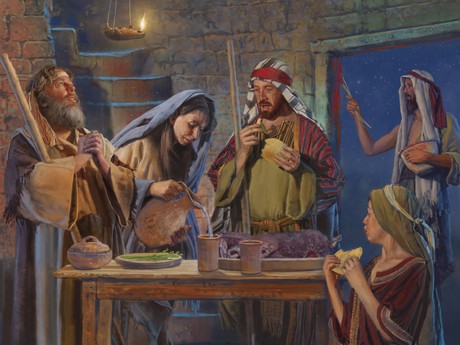

Image result for passover meal


The lamb foreshadows Jesus Christ.

Therefore purge out the old leaven, that you may be a new lump, since you truly are unleavened. For indeed Christ, our Passover, was sacrificed for us.(1 Corinthians 5: 7)

Christ is called Lamb in the scripture. The lamb is set apart four days before the Passover. Our Lord Jesus Christ was set apart as the Lamb of God before the foundation of the world. In the fullness of time the was crucified.

All who dwell on the earth will worship him, whose names have not been written in the Book of Life of the Lamb slain from the foundation of the world.(Revelation 13:8)


Just as the Passover lamb was burned in fire, Christ suffered in the fire of the wrath of God. The command the bones of the Lamb should not be broken was also fulfilled in Jesus Christ. His legs were not broken although the legs of the other two on the cross were broken. " Even Christ out Passover Lamb is sacrificed for us" Thus we are delivered from death which is the wages of out sin and from the bondage of Satan.


2. The Liberated Israel : People of Israel who were delivered from the bondage of Egypt be the blood of the Passover Lamb stand for New Testament believers. Our salvation is only through the blood of Jesus Christ. There is no condemnation for those who believe in him. Just as Passover marked the beginning of the year of Israel, faith in the sacrificial death of Jesus Christ opens a new chapter in out lives. Putting blood at the door posts shows that we are taking refuge in Him be faith. Eating of the roasted meat points towards the need to know Christ deeply and experience Him on our lives. It also signifies the participation of God's people in the Lord's Table. Believers must grow in strength through the partaking of Christ.

3. Unleavened Bread: Leaven represents uncleanness. Believers must keep holiness in life and doctrines. God commands: Do not touch any unclean things.


4. Bitter herb: when we are part of Christ, there will be experiences of bitterness and sorrows in this world. Jesus warned His disciples: " In the world you shall have Tribulation: but be of good cheer" (John 16:30). Apostles exhorted delivers we must go through much tribulation enter into the kingdom of God.


 strengthening the souls of the disciples, exhorting them to continue in the faith, and saying, "We must through many tribulations enter the kingdom of God." (Acts 14:22)

5. Eating the Passover meal in haste with loins girded, shoes on feet and staff on hand: believers must be ready to do service as per the example shown by our Lord. Our feet must have the preparation for the Gospel, of peace. Like Abraham we must consider out selves as strangers and pilgrims looking for the heavenly city. Let us always remember that we are journeying from this land of destruction to the city of Zion.

6. The Passover meal should not be eaten by a stranger: Only the saved ones have fellowship with God and His Church.

Are you saved by the blood of the Lamb of God? Do you have constant fellowship with Jesus Christ and the Church of God?


Lesson 11

FESTIVALS OF JEHOVAH 

Related image

Reading: Lev 23

Memory verses: 2 Cor. 2: 14, Pas. 118:15

Theme: To celebrate the victory and joy of life in Jesus Christ

Introduction: Is Christian life joyful or sorrowful? What is your personal opinion? Do the people whom you know praise God and rejoice in all circumstances of their life? Paul and Silas sang praises to God in the prison of Philippi

 But at midnight Paul and Silas were praying and singing hymns to God, and the prisoners were listening to them.(Acts 16:25)


Paul asks the Philippians to rejoice in the Lord always when the writes to them from the prison of Rome.

Rejoice in the Lord always. Again I will say, rejoice! (Phil 4:4)

The voice of rejoicing and victory will be in the tabernacles of God's people. Festivals if Israel are shadows of this truth. As these are given to Israel by God Himself the festivals are called the Festivals of Jehovah.

REASONS FOR GIVING THE FESTIVALS OF ISRAEL


1. It was the will of God that people who were delivered from Egypt should enjoy not only peace and rest but also happiness and joy in their life.

 You shall rejoice before the Lord your God, you and your son and your daughter, your male servant and your female servant, the Levite who is within your gates, the stranger and the fatherless and the widow who are among you, at the place where the Lord your God chooses to make His name abide. 12 And you shall remember that you were a slave in Egypt, and you shall be careful to observe these statutes. (Deuteronomy 16:11,12)

But their joy should be in the presence of God. Therefore, festivals were instituted by God to give them spiritual, happiness and sustain them in that happiness. New Testament believers also must rejoice in the Lord always.

2. It was the practice in Israel to hear the Word of God during the festival. People gathered together on the first day of the seventh month at the time of Nehemiah. Ezra stood up on a platform and read the law to the people from morning till noon. They rejoiced hearing the Law. It is an experience of joy to read, hear and meditate on the word of God.

Related image

 Now all the people gathered together as one man in the open square that was in front of the Water Gate; and they told Ezra the scribe to bring the Book of the Law of Moses, which the Lord had commanded Israel. 2 So Ezra the priest brought the Law before the assembly of men and women and all who could hear with understanding on the first day of the seventh month. 3 Then he read from it in the open square that was in front of the Water Gate from morning until midday, before the men and women and those who could understand; and the ears of all the people were attentive to the Book of the Law. 4 So Ezra the scribe stood on a platform of wood which they had made for the purpose; and beside him, at his right hand, stood Mattithiah, Shema, Anaiah, Urijah, Hilkiah, and Maaseiah; and at his left hand Pedaiah, Mishael, Malchijah, Hashum, Hashbadana, Zechariah, and Meshullam. 5 And Ezra opened the book in the sight of all the people, for he was standing above all the people; and when he opened it, all the people stood up. 6 And Ezra blessed the Lord, the great God. Then all the people answered, "Amen, Amen!" while lifting up their hands. And they bowed their heads and worshiped the Lord with their faces to the ground. 7 Also Jeshua, Bani, Sherebiah, Jamin, Akkub, Shabbethai, Hodijah, Maaseiah, Kelita, Azariah, Jozabad, Hanan, Pelaiah, and the Levites, helped the people to understand the Law; and the people stood in their place. 8 So they read distinctly from the book, in the Law of God; and they gave the sense, and helped them to understand the reading. (Nehamaiah 8:1-12)


3. Gathering of people from different places at one location during the festivals was providing opportunities to know each other and enjoy loving fellowship. In those days when communications were difficult, festivals helped people to remain as nation. Believers should endeavor to help each other and be in fellowship. Forget not to do good and to communicate.

But do not forget to do good and to share, for with such sacrifices God is well pleased.(Hebrew 13:6)

4. Festivals served as a reminder to other nations about the strength of Israel and prevented attack on them. Enemies of the gospel will be afraid if believers stand together. The Lord wants His people to be perfect in unity.

Now I am no longer in the world, but these are in the world, and I come to You. Holy Father, keep through Your name those whom You have given Me, that they may be one as We are. (John 17:11)


5. Festivals were occasions for people to bring their tithes offerings and voluntary donations to the Temple of God. New Testament believers are duty bound to give bountifully for Lord's work from their material blessings.

But this I say: He who sows sparingly will also reap sparingly, and he who sows bountifully will also reap bountifully. 7 So let each one give as he purposes in his heart, not grudgingly or of necessity; for God loves a cheerful giver.( 2. Cor.9:6,7)


6. Festivals of Israel prevented them from observing festivals of the heathen. They were commanded to observe separation and holiness as God's special people. Believers must keep themselves separated from heathen festivals and find joy in the presence of God along with other believers.

7. Festivals contained great prophetic meanings. They foreshadowed Christ's death and resurrection. His second coming, the millennium etc. In the New Testament age, we have to experience the substance of the festivals. How foolish it will be if we still run after the shadow!

Hebrew months: Days were allotted for the celebration of the festivals. The month in which they were liberated from Egypt was the first month in their calendar. Let us learn the Hebrew months in their order.


1. Abib (Nisan)  - Esther 3:7

2. Ziv   - 1 king 6:1

3. Sivan  - Esther 8:9

4. Thammuz - Ezekiel 8:14

5. Ab   - Ezra 7:9

6. Elul -  Nehemiah 6:15

7. Ethanim  (Tissri) - 1 king 8:2

8.Bul (Marchesvan) -  1 King 6:38


9. Chislev - Zachariah 7:1

10. Tebeth -  Esther 2:16

11. Shebath - Zachariah 1:7

12. Adar - Esther 8:11


Seven festivals God had given Israel seven festivals. All males in Israel were commanded to gather together in the presence of God on three seasons of the year and celebrate the festivals.


 "Three times you shall keep a feast to Me in the year 15 You shall keep the Feast of Unleavened Bread (you shall eat unleavened bread seven days, as I commanded you, at the time appointed in the month of Abib, for in it you came out of Egypt; none shall appear before Me empty); 16 and the Feast of Harvest, the firstfruits of your labors which you have sown in the field; and the Feast of Ingathering at the end of the year, when you have gathered in the fruit of your labors from the field. 17 Three times in the year all your males shall appear before the Lord God.(Exodus 23: 14 -17)


1. Passover                             : Month 1 Day 14

2. Unleavened bread              : Month 1 Day 15 - 21

3. First fruits                          : Month 1 Day 16

4. Pentecost (feast of weeks) : Month 3 Day 6

5. Trumpets                           : Month 7  Day 1

6. Atonement                         : Month 7 Day 10

7. Tabernacles                        : Month 7 Day 15 - 22   


The three festivals in the first month are referred to as Passover feast or the fest of the unleavened bread. As the fourth festival falls on the fiftieth day after the festival of the first fruits, it is known as the feast of Pentecost or the festival of the weeks. The three festivals falling in the seventh month are together known as the fest of the tabernacles.

OTHER FESTIVALS OF ISRAEL

Two more festivals were added in Israelite calendar later on.

1. Feast of the dedication :

 Now it was the Feast of Dedication in Jerusalem, and it was winter. (John 10:22)

Antiochus Ephiphanus, the Syrian king desecrated the Temple of Jerusalem by sacrificing a pig in it. Temple was reclaimed by Maccabees and dedicated once again. To commemorate this event, Israel started to observe on the feast of dedication on the 25th day to the 8th month from B.C 164. On that day Jewish homes would be illuminated and the heroic deeds of the Maccabees would be narrated to their children.


2. Festival of Purim:

And Mordecai wrote these things and sent letters to all the Jews, near and far, who were in all the provinces of King Ahasuerus, 21 to establish among them that they should celebrate yearly the fourteenth and fifteenth days of the month of Adar, 22 as the days on which the Jews had rest from their enemies, as the month which was turned from sorrow to joy for them, and from mourning to a holiday; that they should make them days of feasting and joy, of sending presents to one another and gifts to the poor. 23 So the Jews accepted the custom which they had begun, as Mordecai had written to them, 24 because Haman, the son of Hammedatha the Agagite, the enemy of all the Jews, had plotted against the Jews to annihilate them, and had cast Pur (that is, the lot), to consume them and destroy them; 25 but when Esther came before the king, he commanded by letter that this wicked plot which Haman had devised against the Jews should return on his own head, and that he and his sons should be hanged on the gallows. 26 So they called these days Purim, after the name Pur. Therefore, because of all the words of this letter, what they had seen concerning this matter, and what had happened to them, (Esther 9:20-25)


When Haman, the minister of king Ahasuerus plotted to annihilate the Jewish race, they were saved miraculously by God's providence. Thus Purim was declared as days of joy and victory on 14th and 15th Adar (12th month). This festival which was instituted in the 5th century BC is being celebrated as the Jewish national day. Purim means 'lot'. The day which was selected by Haman through casting lots to destroy Israel turned out to be their day of celebration.

All festivals of Israel were days of joy which teach us many spiritual truths. Praise God for the joy that we enjoy through Jesus Christ. 


Saturday, November 17, 2018

Lesson 10

TRESPASS OFFERING 


Reading: Lev. 5: 1-16, 7:1-10
Memory verses : Micah 7: 18,19

Theme: These is remission in Christ for all our sins not only those inherited by birth but also trespasses committed individually. Let us, therefore, experience the joy of forgiveness of all-out sins in our lives. 

Introduction: We are currently studying the details about sacrifices. How many important sacrifices are there? Which are the sweet savour offering and which are the not-sweet savour offering? The first type of sacrifices shows that Christ became in the sight of God and the second type show what He became for us. We identify ourselves with Christ in the sweet savour offering while Christ identifies Himself with us in the nonsweet savour offerings. Sin offering teaches us that we are sinners by birth and the remission of our sins can be obtained through the sacrifice of Jesus Christ. Trespass offering shows that there is remission through Christ for the trespasses committed by us individually. 


TRESPASSES 


Sin is the nature that man has acquired by birth. Trespasses are those transgressions of the law which man commits individually in his life. Trespasses are those deeds which go outside the boundaries of the law. There are two types of trespasses:

1) Those against  God 

2) Those against man 

Look at the ten commandments given by God through Moses. The first four of those are concerned with man's relationship with God. The other six are concerned with man's relationship with the man. The breaking of these laws constitutes trespasses. Trespass offering is instituted to obtain remission of these transgressions. Through the death of Christ on the cross, a believer obtains forgiveness for his sin and sins. We have redemption through His blood, the forgiveness of sins


Sacrificial objects: The worshiper was permitted to offer any one of the following objects according to his ability as a trespass offering:

1. A female goat or lamp
2. Two turtle doves or two young pigeons
3. Tenth part of an ephah of fine flour
4. A ram if the trespass os against the holy things of the Lord


Method of offering: The method was the same as that of a sin offering. The worshiper brings the animal at the entrance to the tabernacle, places his hand upon its head and kills it. The priest takes some of its blood and sprinkles it round about the altar. The remaining blood is poured out at the foot of the altar. The fat, the kidneys and the caul are burnt on the altar. Priests eat the remaining portions of the flesh inside the court of the tabernacle. If the offering consists of turtledoves or pigeons, priest wrings off the head of one of them, sprinkles some of its blood on the altar and the rest poured at the foot of the altar. The other dove is offered as a burnt offering on the altar. It the offering is fine flour, no oil or frankincense is added. A priest takes a handful of the flour and burns it on the altar. The remaining flour is like a meal offering for the priest. If the offering is a ram, priest sacrifices it as a trespass offering.

The different articles for the offering signify different aspects of the divine nature of Jesus Christ. What do goat, sheep, dove and fine flour shows? Jesus Christ suffered silently to bring forgiveness for our sins and trespasses


 He was oppressed and afflicted, yet he did not open his mouth; he was led like a lamb to the slaughter, and as a sheep before its shearers is silent, so he did not open his mouth. (Isaiah 53:7)

Christ redeemed us from the curse of the law by becoming a curse for us, for it is written: “Cursed is everyone who is hung on a pole.”  (Galatians. 3:13)


Jesus was born poor and suffered sorrows and presented His unblemished life to His Father. Let us praise God for the great salvation that we have received through His death on the cross.


Compensation: If the trespass offering is in connection with the holy things of God or with the property of a friend, the guilty person has to pay compensation for the cost and fifth more. This is a speciality of trespass offering. There are two spiritual meanings underlying the compensation clause;

1). Christ's death has restored all the losses of mankind completely. The glory that is in store for the redeemed children of God is much more than the glory that Adam had before his fall. God has saved us by the gospel to give the glory if Jesus Christ.

2). A man who repents and is saved must compensate for the trespasses that he committed against God and men earlier seek pardon from those whom he wronged; return properties wrongly acquired; be reconciled with people where reconciliation is needed. When Zacchaeus came into contact with Jesus, see what happened in this life.

But Zacchaeus stood up and said to the Lord, “Look, Lord! Here and now I give half of my possessions to the poor, and if I have cheated anybody out of anything, I will pay back four times the amount.”  (Luke 19:8)


Saturday, October 20, 2018

Lesson 9

SIN OFFERING

Reading: Lev. 4, 6:24-30
Memory verse: 1 Pet. 2:24

Theme: To lead a holy life after obtaining remission of sins by faith in Jesus Christ who became a sacrifice on the cross bearing sins of all mankind.

Introduction: What is it that keeps a man away from fellowship with God? How did sin enter into the world? What happened to mankind by the disobedience of Adam and Eve? Jesus Christ came to this world as a man and took upon Himself the punishment for our sins and suffered death on the cross. Sin offering was instituted for Isreal as a shadow of Christ's sacrifice. Christ was made sin for us.

God made him who had no sin to be sin for us, so that in him we might become the righteousness of God. (2 Corinthians 5:21)

Sin offering is one of the two non-sweet savour offerings. A person was required to offer sin offering at first when he comes to the presence of God. 

PEOPLE WHO WERE REQUIRED TO OFFER SIN OFFERING 

Four types of people were commanded to offer sin offering. 

1) Priest
2) Congregation of Isreal 
3) Elders of the people 
4) Ordinary Israelite


All people are covered by these four groups. It proclaims the truth that all have sinned and come short of the glory of God.

 for all have sinned and fall short of the glory of God. (Romans 3:14)

As all are sinners every one needs remission of sins. Even by birth, man is a sinner and with the nature of sin. Every sin committed, whether inadvertently or not needs remission.

SACRIFICIAL ANIMALS AND METHOD OF OFFERING 

People belonging to the above four groups were commanded to offer sacrifices differently. The differences point to different aspects of the death of our Lord.

1. Sacrificial animals to be offered by the priest and congregation of Isreal were of the same type. The animal was young bull if the offering is for himself and the elders of Isreal would do the same if it is for the whole congregation. The animal is, then killed. The priest takes some blood of the animal, enters the Holy Place in the tabernacle, sprinkled it before the veil seven times and smears it on the horns of the altar of incense. The remaining blood is poured at the foot of the altar of burnt offering. Fat, kidneys and covering the liver are burnt on the altar of burnt offering. All the remaining portions of the animal are taken outside the camp to a clean place meant for dumpling ash and then burnt on a wood fire. 

Christ who came down in the form of servant took out sins and became a sin offering of Calvary. The sprinkling of blood in front of the veil signifies that we can enter into the presence of God.

 But when Christ came as high priest of the good things that are now already here, he went through the greater and more perfect tabernacle that is not made with human hands, that is to say, is not a part of this creation. He did not enter by means of the blood of goats and calves; but he entered the Most Holy Place once for all by his own blood, thus obtaining eternal redemption. The blood of goats and bulls and the ashes of a heifer sprinkled on those who are ceremonially unclean sanctify them so that they are outwardly clean.  How much more, then, will the blood of Christ, who through the eternal Spirit offered himself unblemished to God, cleanse our consciences from acts that lead to death, so that we may serve the living God! (Romans 9:11-14)


The smearing of blood on the horn of the altar of incense points to the privilege that has come to us for worshipping God. IT also signifies the intercessory prayer of Christ. Pouring of blood at the foot of the altar shows reconciliation that we have received individually with God. All the remaining portions of the animal are burnt outside the camp of Isreal. It points to the suffering the Christ had to undergo outside Jerusalem. We must also be prepared to bear His reproach and suffer outside the camp.

2. Sacrifices of elders and ordinary Israelite: An elder offers a male goat and an ordinary Israelite offers either a female goad or a female lamb. The procedure for the offering was the same in both cases. The worshiper places his hand upon the head of the animal and kills it at the entrance to the tabernacle. The priest dips his finger in the blood, smears the blood on the horns of the altar of burnt offering and pours the remaining blood at the foot of the altar. Blood is not taken inside the Holy Place. Fat and kidneys of the animal are burnt on the altar. The remaining flesh is cooked and eaten by the priests inside the court of the tabernacle. "All the males among the priests shall eat thereof: it is mot holy". This points to the fellowship of the children of God who are priests. Every child of God who has obtained remission of sins through the sacrifice of Jesus Christ most keep themselves continually in fellowship with God and His people. This fellowship also stands for the Lord's Table. 

Have you received remission of your sins by accepting Jesus Christ as your Saviour? If so, the Lord requires you to suffer for Him outside the camp, leaving all worldly pleasures. Are you prepared for it? Are you keeping in constant fellowship with God and His children?

Saturday, October 13, 2018

Lesson 8

PEACE OFFERING 
Reading: Lev. 3, 7: 11-37

Memory verses: Eph. 2: 14-17

Theme: To experience the peace that Jesus Christ gives.

Introduction. Many kinds of conflicts are seen in the world. What is the reason? Conflict begins in the life of individuals and spreads into society. Therefore the solution to conflicts in society will come about if individuals enjoy peace. Individual must experience peace with God and then with fellow men. The peace offering was the shadow of the sacrifice of Jesus Christ which alone can provide peace to man abundantly.

 SACRIFICIAL ANIMAL 


A blemishless animal from among cattle or sheep can be offered as a peace offering. It is different from burnt offering in one aspect that the animal can either be male or female. Each animal (Bullock, goat, sheep) point to a particular character of Jesus Christ as we have already learned.  Although God is pleased and His righteousness is fulfilled through peace offering also, the emphasis there is on the worshiper. His infirmity or weakness is acknowledged in the female animal which may also be offered as a peace offering.


METHOD OF OFFERING

The worshipper brings the animal to the entrance of the tabernacle and places his hand on its head. The animal is then killed and the priest sprinkles its blood on the altar, Its fat and kidneys are burned on the altar. The breast of the animal is waved by the priest as a wave offering and its portions set apart for the priests. The remaining flesh is eaten by the worshipper with his family inside the court of the tabernacle. It should not be eaten outside and by an unclean person.

Meaning of the sacrifice. We are reconciled to God by the death of Jesus Christ on the cross. We were once far away from God, in enmity with Him and children of wrath. Jesus Christ suffered in His body the chastisement for our peace. He is our peace. 

But now in Christ Jesus you who once were far away have been brought near by the blood of Christ.

For he himself is our peace, who has made the two groups one and has destroyed the barrier, the dividing wall of hostility, by setting aside in his flesh the law with its commands and regulations. His purpose was to create in himself one new humanity out of the two, thus making peace,  and in one body to reconcile both of them to God through the cross, by which he put to death their hostility.  He came and preached peace to you who were far away and peace to those who were near.  For through him we both have access to the Father by one Spirit. (Ephesians 2:13- 18)


By making peace it is not only that the enmity is removed, but also that an active fellowship with God and the inheritance of sonship are restored. God is pleased with the peace offering and the worshiper and his family become its partakers deriving happiness and satisfaction. Peace offering can also be considered as pointing towards the observance of the Lord's Table which symbolises our fellowship with God and His people. Devine peace fills and overflows in the heart of the person who has obtained peace with God and man. This is the peace of God that passes all understanding. This is the same peace which Jesus gave to his disciples.

 Peace I leave with you; my peace I give you. I do not give to you as the world gives. Do not let your hearts be troubled and do not be afraid. (John 14:27)


TWO TYPES OF PEACE OFFERING 


1. Thanks giving offering : Lev. 7:12-15


2. Vow or voluntary offering: Lev. 7:16-19

Unleavened cakes and wafers baked with oil are offered with peace offering as Thanksgiving. Besides, leavened bread is also permitted. This is quite significant. The emphasis in peace offering is on the worshipper who is weak and with infirmities if the flesh. Although the worshiper is reconciled with God, he is still living in this body where there is constant warfare between flesh and spirit. The part of victory is to mortify the deeds of the body by the spirit continually and burn them on the altar.

 So I find this law at work: Although I want to do good, evil is right there with me. (Romans 7:21)

The portions of flesh set apart for the worshipper in the thanksgiving offering must be eaten on the same day. As our blessings through Christ are new every day. we must praise Him in the newness of Spirit with new songs.

The worshipper portions of the vow offering can be eaten on the same day and the next day. This points to the fact that vow we take with God and its joy are not temporary, but enduring.

Being justified by faith, we have peace with God through our Lord Jesus Christ. Hence we must observe peace with all men and seek after holiness.

Make every effort to live in peace with everyone and to be holy; without holiness no one will see the Lord. (Hebrews 12:14)

Let the peace of Christ reign on our hearts.

 Let the peace of Christ rule in your hearts, since as members of one body you were called to peace. And be thankful.(Colossians 3:15)


Lesson 7

MEAT (MEAL) OFFERING 

Reading: Lev. 2, 6:14 -23

Memory Verses: Eph 1:4-6


Theme: To consecrate ourselves to holiness keeping in mind the significance of meal offering and the example of holy life that Jesus Christ offered in the presence of God.

Introduction: It is sin that separates man from God. What is it thatGod desires from man?

 But just as he who called you is holy, so be holy in all you do;  for it is written: “Be holy, because I am holy.” (1 Peter 1: 15,16)

We see the example of a holy life in the life of Jesus Christ. Meal offering represents the holy and consecrated life that Jesus presented before man and God.

MATERIALS FOR THE OFFERING 

Meal offering is a sacrifice without blood and three types of materials can be used for the offering.

1. Fine Flour
It points to the purity and meekness of Jesus Christ whose nature does not contain any anger or guilt.

To this you were called, because Christ suffered for you, leaving you an example, that you should follow in his steps.

 “He committed no sin,
    and no deceit was found in his mouth.”

 When they hurled their insults at him, he did not retaliate; when he suffered, he made no threats. Instead, he entrusted himself to him who judges justly.(1 Peter 2:21-23)


2. Unleavened cakes and wafers baked with oil


The cakes and wafers are made with fine flour. Fine flour represents purity if nature and oil represent Holy Spirit. There should not be any leaven (guilt or wickedness) in the offering.

2. Green ear of corn dried by fire.

Jesus Christ, the good corn was baked in the fire of the wrath of God and became a sweet savor offering.

MATERIALS TO BE ADDED 

1. Oil


Olive oil was poured on the material being offered. In case of cakes and wafers, they were baked in oil and cut into small pieces. Oil was then poured on them. In other words, the offering should be covered with oil. Oil represents the Holy Spirit. Jesus was born of the Holy Spirit


This is how the birth of Jesus the Messiah came about: His mother Mary was pledged to be married to Joseph, but before they came together, she was found to be pregnant through the Holy Spirit. 

Because Joseph her husband was faithful to the law, and yet did not want to expose her to public disgrace, he had in mind to divorce her quietly.

 But after he had considered this, an angel of the Lord appeared to him in a dream and said, “Joseph son of David, do not be afraid to take Mary home as your wife, because what is conceived in her is from the Holy Spirit. (Mathew 1:18-20)

He was filled with the Holy Spirit before His public ministry. His ministry was in the Holy Spirit. His death and His resurrection were by the Holy Spirit. Lives of believers also must be like this. We must imbibe the purity of Jesus Christ in our lives. Just as the meat offering was soaked in oil, our lives and services should be filled with the Holy Spirit.

2. Frankincense 


Frankincense is sprinkled on the sacrificial material. When it is burned in fire sweet smell fills the air. Jesus Christ walked through villages and towns and preached the gospel and healed all manner of sickness. His fame spread fast all over Galilee. He spread the sweet savour of Joy and healing all over the land. God's children should disseminate sweet savour of God in their surroundings, too. Paul declares in 2 Corinthians 2: 14-15)

But thanks be to God, who always leads us as captives in Christ’s triumphal procession and uses us to spread the aroma of the knowledge of him everywhere. 15 For we are to God the pleasing aroma of Christ among those who are being saved and those who are perishing.(2 Corinthians 2:14,15)


3. Salt 

Salt is a symbol of the covenant. Moreover, salt is a purifier and a preserving agent. One of the main attributes of salt is that it adds flavour. Jesus Christ cleansed many sinners and made them acceptable to society. For example, Samaritan woman, Sinner woman, Zacchaeus, He gave comfort and joy to many by His sweet words and loving actions. All believers must endeavour to add flavours to others by their words and deeds. Remember the words of Jesus: You are the salt of the earth (Matthew 5:13).


MATERIAL WHICH ARE FORBIDDEN FOR USE


1. Leaven 

Wickedness, hypocrisy and false doctrines are equated to leaven in the Word of God.

 Therefore let us keep the Festival, not with the old bread leavened with malice and wickedness, but with the unleavened bread of sincerity and truth. (2 Corinthians 5:8)


There was no trace of any such leaven in Christ. Children of God must observe holiness in their lives. We must be examples to others in our words deeds love faith and purity. Hypocrisy should not have any place in us. We must hold fast to the true doctrines of the Word of God.

2. Honey 


Honey represents the natural sweetness. When Jesus lived on the earth, He had no form nor comeliness and no beauty to be desired, He was despised and rejected by men and a man of sorrows and acquainted with grief. Let us mont desire external comeliness, but let our inner beauty be pleasing as a meal offering before God.


Your beauty should not come from outward adornment, such as elaborate hairstyles and the wearing of gold jewelry or fine clothes. Rather, it should be that of your inner self, the unfading beauty of a gentle and quiet spirit, which is of great worth in God’s sight. (1 Peter 3:3,4)

SPECIALITIES OF THE MEAL OFFERING

1. Meal offering was a bloodless sacrifice. Sacrifices with blood show that Jesus Christ has done for us through His death. But the bloodless meal offering shows what He has done for us before His death through His pure life. It shows the blessing that flows towards us from his spotless life. 

2. Materials offered for this sacrifice are made from fine flour. Produced by labour of man. Hence meal offering points to the necessity of making a diligent effort towards holiness in life. 


3. Only a part of meal offering is burned while the remaining is eaten by the priest. The worshipor does not eat out of his offering. God pleased by the meal offering presented by the our life of Jesus Christ and the redeemed believers who are priests also become partakers of the offering.

Meal offering teaches us many spiritual lessons touching our practical lives. We have to present ourselves as a living sacrifice, holy and acceptable unto God. Let us crucify our fleshly and selfish desires. Let us dedicate ourselves in the presence of God to live a life filled with the Holy Spirit, spreading the sweet savour of Christ in the world and imparting flavour to other people. Let our lives also be a sweet savour offering to God as the life of Jesus Christ.


Sunday, September 23, 2018

Lesson 6

BURNT OFFERING 

Reading: Lev.1, 6:8-13
Memory verses: Eph. 5:1-2


Theme: Let us offer ourselves as sacrifices for God just as Jesus Christ, the substance of all sacrifices offered Himself as burnt offering on the altar of the cross.

 Introduction: We have learned that all sacrifices were shadows of the death of Jesus Christ on the cross. In the first chapter if Leviticus, we read about the burnt offering. It is also called an offering made by fire. It is pointing towards Jesus who offered Himself completely to God through His spotless life and through His death. God requires of us a complete surrender.

Therefore, I urge you, brothers and sisters, in view of God’s mercy, to offer your bodies as a living sacrifice, holy and pleasing to God—this is your true and proper worship.  Do not conform to the pattern of this world, but be transformed by the renewing of your mind. Then you will be able to test and approve what God’s will is—his good, pleasing and perfect will. (Romans 12:1,2)

1. IT IS TO BE OFFERED VOLUNTARILY 

Both the sin offering and the trespass offering must be offered by all compulsorily. But the burnt offering which is a sweet savor offering is brought before the Lord voluntary. Jesus Christ came down to this world of His own accord to do God's will and make us righteous before God.

 In your relationships with one another, have the same mindset as Christ Jesus: Who, being in very nature God, did not consider equality with God something to be used to his own advantage; rather, he made himself nothing by taking the very nature of a servant, being made in human likeness. And being found in appearance as a man, he humbled himself by becoming obedient to death— even death on a cross! Therefore God exalted him to the highest place and gave him the name that is above every name, (Philippians 2:5-9)

2. SACRIFICIAL ANIMAL

The worshiper is allowed to offer any one of the following according to his capability:
Bullock, sheep, goat, turtle, dove or young pigeon. All these animals and birds represent various characteristics of Christ.

    a) Bullock:


Obeys its master completely and is willing to suffer any hardship for that purpose. Jesus Christ took the form of a servant and suffered at the hands of His own creation. Book of Mark describes Christ as the servant. He is referred to as servant in Isaiah 42:1,2

Here is my servant, whom I uphold, my chosen one in whom I delight; I will put my Spirit on him, and he will bring justice to the nations. He will not shout or cry out, or raise his voice in the streets. (Isaiah 42:1,2)

He obeyed His Father like a servant and worked among men also like a slave. Do we have that attitude?

so he got up from the meal, took off his outer clothing, and wrapped a towel around his waist. After that, he poured water into a basin and began to wash his disciples’ feet, drying them with the towel that was wrapped around him. (John 13:4,5)


b) Sheep:


Out Lord suffered affections quietly like a sheep before the shearers.

He was oppressed and afflicted, yet he did not open his mouth; he was led like a lamb to the slaughter, and as a sheep before its shearers is silent, so he did not open his mouth. (Isaiah 53:7)

We must suffer persecutions patiently.

c) Goat:


A goat carries the sin of the others

He is to lay both hands on the head of the live goat and confess over it all the wickedness and rebellion of the Israelites—all their sins—and put them on the goat’s head. He shall send the goat away into the wilderness in the care of someone appointed for the task. The goat will carry on itself all their sins to a remote place; and the man shall release it in the wilderness.  (Leviticus 16:21,22)


"Cursed is every one that hangs on a tree". Christ became a curse for us.

Christ redeemed us from the curse of the law by becoming a curse for us, for it is written: “Cursed is everyone who is hung on a pole.”   (Galatians 3:13)

God made him who had no sin to be sin for us, so that in him we might become the righteousness of God. (2 Corinthians 5:21)

Goat represents Christ who bears the sins and curses of mankind.

d) Turtledove and young pigeon 


These birds are offered by the poor

 But if she cannot afford a lamb, she is to bring two doves or two young pigeons, one for a burnt offering and the other for a sin offering. In this way the priest will make atonement for her, and she will be clean. (Leviticus 12:8)

Christ became poor for our sake.

For you know the grace of our Lord Jesus Christ, that though he was rich, yet for your sake he became poor, so that you through his poverty might become rich. (2 Corinthians 8:9)

Jesus was born in a manger and lived in this world without a placeto lay His head. Moreover, Like a dove, He cried in pain without anyone coming to help Him. In Gethsemane, " He offered prayers and supplications with strong crying and tears" 

During the days of Jesus’ life on earth, he offered up prayers and petitions with fervent cries and tears to the one who could save him from death, and he was heard because of his reverent submission. (Hebrews 5:7)

He cried out on the cross "My God, my God, why have you forsaken me"

3.CHARACTERISTICS OF THE SACRIFICAL ANIMAL 

a) Without blemish: The animal must be without blemish. Jesus who became a burnt offering for us was without any blemish. He was proved guiltless before God, before the courts, and before the crowd. Father God, Pilate, Thief on the cross, Roman Soldier and others bear witness to this fact.

b)Male animal: The meaning is that it must be strong and brave. Jesus Christ is mighty to save

4. METHOD OF OFFERING

a) The worshiper places his hand on the head of the animal. By this act, he admits that he deserves death for his sins and identifies himself with the animal which is going to die on his behalf. We, too, identify ourselves by faith with the death of Jesus Christ. 

b) The animal is killed. Christ suffered death which was the wages of our sin.

For the wages of sin is death, but the gift of God is eternal life in Christ Jesus our Lord. (Romans 6:23)

c) The animal is skinned. it thus loses its own color. Jesus was counted among trespassers and crucified with thieves. Believers have to forsake their own glory and offer themselves as sacrifices in the presence of the Lord.

d) The animal is cut into pieces and placed on the altar. All the members of our body must be offered totally as Jesus offered Himself for us. Head (intelligence, thoughts), fat (strength, energy), inner portions (emotions, desired), feet (walk, way of life) and everything else must be offered to God.

 Do not offer any part of yourself to sin as an instrument of wickedness, but rather offer yourselves to God as those who have been brought from death to life; and offer every part of yourself to him as an instrument of righteousness. (Romans 6:13)


e) Everything is burnt in fire. Fire does mainly three things:

     i) It fulfills the judgment of God. For example Sodom and Gomorrah, Hell. There is no condemnation for us because Christ became a burnt offering on our behalf.

Therefore, there is now no condemnation for those who are in Christ Jesus. (Romans 8:1)

    ii) It purifies


 But who can endure the day of his coming? Who can stand when he appears? For he will be like a refiner’s fire or a launderer’s soap.  He will sit as a refiner and purifier of silver; he will purify the Levites and refine them like gold and silver. Then the LORD will have men who will bring offerings in righteousness, (Malachi 3:2,3)

When we offered on the altar, we are purified by the divine fire.

     iii) It signifies God's acceptance. The acceptance of Elijah's sacrifice was shown by fire. When we surrender ourselves before God, He shows His acceptance by imparting the Holy Spirit into us. God accepted the supreme sacrifice of Jesus Christ and raised Him from the dead and exalted Him to the highest position. When we surrender ourselves completely, God is pleased in us. As apostle Paul said: Now it is not I who lives, but Christ livesin me.


Sunday, September 16, 2018

Lesson 5

SACRIFICES OF ISRAEL 

Reading: Gen. 4: 1-15; Lev. 1 -7
Memory Verses : Heb:1,14

Theme: To learn that worshiper can attain perfection, not through the Old Testament sacrifices which were merely shadows, but only by the sanctification possible through the supreme sacrifice of Jesus Christ. 

Introduction: Sacrifices were prevalent in the world from the beginning of history. The clothing of skin given by God to the first parents after they sinned can be considered as pointing to the redemptive death of Jesus Christ and as the beginning of sacrifices. Later we see sacrifices being offered by faith by Abel, Noah, Abraham, Issac, Jacob, Job and others. It was through the Law given to Moses on Mount Sinai that God revealed the importance and meaning of sacrifices. All sacrifices were shadows of the single most important sacrifice of Jesus Christ on the cross. The study of various sacrifices will lead us to the understanding the sanctification, perfection, and blessings available through the sacrifice of Jesus Christ.


Levite sacrifices: The commandments given by God regarding sacrifices are recorded in the first seven chapters of the book of Leviticus. Hence they are called Levite sacrifices. There are five important sacrifices. They are burnt offering, meal offering, peace offering, sin offering, and trespass offering 


Details of these five offering are found in the first five chapters of Leviticus. The next two chapters give conditions governing the offerings. Apart from these, there are drink offering, free will offering, thanksgiving offering.

Sacrifices: two types: Out of five Levite sacrifices, the first three are sweet savor offerings and the other two are non-sweet savor offering. Sweet savor offering are those in which sweet smelling materials are also added to the sacrificial animals. These are not added in the non-sweet savor offerings. Sweet savor offerings are associated with worship and non-sweet savor offering are associated with remission of sins. Sweet savor offering tells us how God sees Jesus Christ and the other two offerings show what Jesus Christ has accomplished for mankind. Sweet savor offerings are brought by worshiper voluntarily. On the other hand, worshiper is commanded to bring sin and trespass offerings, A sinner must offer sin and trespass offering first. After that, he is entitled to offer the other sacrifices which are thanksgiving offerings.

Meaning of sacrifices:  Various sacrifices were offered continually in the Old Testament age. They were all shadows of the single sacrifice of Jesus on the Calvary.

 And by that will, we have been made holy through the sacrifice of the body of Jesus Christ once for all. 11 Day after day every priest stands and performs his religious duties; again and again he offers the same sacrifices, which can never take away sins. 12 But when this priest had offered for all time one sacrifice for sins, he sat down at the right hand of God, 13 and since that time he waits for his enemies to be made his footstool. 14 For by one sacrifice he has made perfect forever those who are being made holy. (Hebrews 10:10-14)

The essence of all the five sacrifices is contained in that single sacrifice. The death of Jesus Christ brought glory and honor to the name of God. Therefore, Jesus Christ became a sweet smelling sacrifice for God. Moreover, His death was sufficient for the remission of the sins of mankind. "In the end of the world, He appeared to 

 For Christ did not enter a sanctuary made with human hands that was only a copy of the true one; he entered heaven itself, now to appear for us in God’s presence. 25 Nor did he enter heaven to offer himself again and again, the way the high priest enters the Most Holy Place every year with blood that is not his own. 26 Otherwise Christ would have had to suffer many times since the creation of the world. But he has appeared once for all at the culmination of the ages to do away with sin by the sacrifice of himself..(Hebrews 9:24-26)


1 My dear children, I write this to you so that you will not sin. But if anybody does sin, we have an advocate with the Father—Jesus Christ, the Righteous One. 2 He is the atoning sacrifice for our sins, and not only for ours but also for the sins of the whole world.(1 John 2:1-2)


Therefore, the substance of all the propitiatory offerings is Christ, Himself.

Jesus Christ was not only the sacrificial animal But also the High Priest who offered the sacrifice and even the altar where the sacrifice was offered, In the Old Testament sacrifices, the alter the sacrifice and the priest were all different. But in the ultimate sacrifice, all these three have merged into one person, Jesus Christ. Let us praise God for the unique sacrificial death of the unique Christ. At the same time let us offer our selves as sacrifices in the presence of God.