Monday, July 8, 2019

Lesson 14

FESTIVAL OF PENTECOST 

Reading: Lev. 23: 15-22; Act 2

Memory verses: Acts 2: 17-18


Theme: To lead a Spirit-filled life after being anointed by the Holy Spirit.

Introduction: What is the name by which churches giving importance to the anointment of the Holy Spirit and know? What is the reason for that? It was on the Israeli festival day of Pentecost that Jesus Christ poured out the Holy Spirit on His disciples after His ascension to heaven. Pentecost stands for the pouring out of the Holy Spirit. This festival was celebrated on the 6th of the 3rd month of Sivan. It was the 50th day after the festival of the first fruits. 


DIFFERENT NAMES OF THE FESTIVAL.


The festival of Pentecost comes on the day after counting seven weeks and seven Sabbaths from the festival of the first fruits. Therefore it is also called the festival of the weeks. As it falls on the 5oth day after the festival of the first fruits, it came to be known as 'Pentecost' which means '50'. It occurs after the harvest and hence it is also known as the harvest festival. The name day of first fruits is also given to it as people offer first fruits of trees on this day.


METHOD OF OBSERVANCE


Sunday, July 7, 2019

Exam preparation

Sunday School Exam Preparation 


1. What is the difference between the ministries of prophets and priests?

Answer: A priest stands between people and God and speaks to God on behalf of people. A Prophet speaks messages from God to people. The priesthood was bestowed on one particular among Israel. On the other hand, prophets arose from common people.


2. What was the secret of Isaiah's victorious life?

Answer:  Victory in the life of Isaiah can be summarized in five words:
                  1. Conviction (Isa. 6:5): "Woe is me and I am undone"
                  2. Confession (Isa. 6:5): " I am a man of unclean lips"
                  3. Cleaning (Isa. 6:7): "Your iniquity is taken away and your sin purged"
                  4. Consecration (Isa:7) " Here am I, send me"
                  5. Commission (Isa. 6:9) " Go and tell these people"
3. Name the two prophets who lived during Babylonian captivity?

Answer: Daniel and Ezekiel  

4. Describe the battle of Armageddon?

Answer: When the news of the arrival of Christ on mount Olives reaches anti-Christ, he will be filled with fear and wrath. He will gather all his armies in the valley of Megiddo situated on the west side of Jerusalem and on the east of the Mediterranean sea and will establish his headquarters there. Many nations from the north and the east will send their armies with modern armaments to help him. Jesus Christ who is the lion of Judah will shout with a loud voice resounding throughout earth and heavens.
Archangel Micael will rise on the side of Israel. The terrifying armies of anti-Christ will fight with each other and many will be killed. Their flesh will decay even while they are standing. There will be an earthquake and mountains will fall on the armies. Hail storm will kill many more. Thus the armies of the anti-Christ will be destroyed suddenly. Blood will flow for 200 miles. The anti-Christ and his associate the false prophet will be bound and cast into the lake of fire. Thus the Lord will destroy the anti-Christ "by the spirit of His mouth and the brightness of His coming"


5. Explain six types of crowns mentioned in the scripture?

 Answer:

 1. Crown of Life: For those who are faithful till the end in the midst of adversities(James 1:12)
 2. Crown of Righteousness: For those who fight the good fight keep their faith and finish their course. (2. Tim 4:8)

3. Incorruptible Crown: For those who keep their separation with the world (1 Cor.9:25)
4. Crown of Glory: For the elders who are good examples to folk in their charge ( 1 Peter 5:4)
5. Crown of Rejoicing: For those who bring souls to salvation by their ministry ( 1 Thes. 2:19)
6. Crown of Gold: For all saints as a symbol of their royalty (Rev. 4: 4-11)


6. What has Enoch prophesied about the Lords second coming and where is it recorded?

Answer: Enoch belonging to the seventh generation from Adam, walked with God and received messages from God. He prophesied that the Lord would come along with thousands of saints to judge the earth. This prophecy is recorded in the epistle of Jude 15,16. It is pointing to the second phase of the Lord's coming.


Remaining questions from chapter 1 to 14 (You can see in this blog)


Study any 3 memory verses 

Memory verses: Heb. 1:1,2
Memory Verses: Heb 4:14 - 16
Memory verse: Heb.2:9
Memory Verses: Rom. 12: 1-2 
Memory Verses : Heb:1,14
Memory verses: Eph. 5:1-2
Memory Verses: Eph 1:4-6


Saturday, May 11, 2019

Lesson 13

FESTIVALS OF UNLEAVENED BREAD AND FIRST FRUITS 

Reading : Exo.12:15-20
               : Deut. 16:2-8, Lev.23:6-14
Memory verse: 2 Cor.7:1

Introduction: Passover is the first and most important festival in Israel. The festivals of unleavened bread and first fruits are also observed in the same month as the Passover. All three festivals are some times referred to as the Passover. or the feast of the unleavened bread. Passover lamb is killed in the evening of 14th of the 1at month. Festival of the unleavened bread is observed for a week from the 15th to 21st. Since Jews count the day from evening to evening, the feast of the unleavened bread actually starts when Passover is observed in the evening of 14th. Festival of the first fruits is also falling in the same week. It is observed on the day after the Sabbath ( first day if the week) which immediately follows Passover. 


Feast of the unleavened bread: People have to eat unleavened bread on all the seven days of this festival. The burnt offering should be sacrificed for the Lord every day. Holy assemblies should be held on the first day and the seventh day. No regular work should be done any day.

Spiritual Lessons: 


1. 'Leaven' represents malice and wickedness. 'Seven' points to perfection. We are saved when we put our faith in the atoning death of Christ. After that, we must live a perfect and holy life. Just as He who called us is holy, we must be holy in all that we do as obedient children.

As obedient children, do not conform to the evil desires you had when you lived in ignorance. But just as he who called you is holy, so be holy in all you do;  for it is written: “Be holy, because I am holy.” (1 pet 1:14-16)

Make every effort to live in peace with everyone and to be holy; without holiness, no one will see the Lord. (Hebrews 12:14)


Get rid of the old yeast, so that you may be a new unleavened batch—as you really are. For Christ, our Passover lamb, has been sacrificed. 8 Therefore let us keep the Festival, not with the old bread leavened with malice and wickedness, but with the unleavened bread of sincerity and truth. (1Corinthians5:7-8)

2. Leaven represents false doctrines. We must hold fast to the pure doctrines that have been entrusted to us once for all.

7 They discussed this among themselves and said, “It is because we didn’t bring any bread.”

8 Aware of their discussion, Jesus asked, “You of little faith, why are you talking among yourselves about having no bread? 9 Do you still not understand? Don’t you remember the five loaves for the five thousand, and how many basketfuls you gathered? 10 Or the seven loaves for the four thousand, and how many basketfuls you gathered? 11 How is it you don’t understand that I was not talking to you about bread? But be on your guard against the yeast of the Pharisees and Sadducees.” 12 Then they understood that he was not telling them to guard against the yeast used in bread, but against the teaching of the Pharisees and Sadducees. (Mathew 16:5-12)


3. Hypocrisy is also pictured as leaven. Jesus Christ condemned hypocrisy vehemently. Believers must keep all such leaven out of their lives. 

 Meanwhile, when a crowd of many thousands had gathered, so that they were trampling on one another, Jesus began to speak first to his disciples, saying: “Be[a] on your guard against the yeast of the Pharisees, which is hypocrisy. (Luke 12:1)

4. Believers must also present themselves as a burnt offering to God continually. Moreover, they must assemble together with other believers and worship God.


Therefore, I urge you, brothers and sisters, in view of God’s mercy, to offer your bodies as a living sacrifice, holy and pleasing to God—this is your true and proper worship. 2 Do not conform to the pattern of this world, but be transformed by the renewing of your mind. Then you will be able to test and approve what God’s will is—his good, pleasing and perfect will. (Romans 12:1-2)


Festival of the first fruits 


9 The Lord said to Moses, 10 “Speak to the Israelites and say to them: ‘When you enter the land I am going to give you and you reap its harvest, bring to the priest a sheaf of the first grain you harvest. 11 He is to wave the sheaf before the Lord so it will be accepted on your behalf; the priest is to wave it on the day after the Sabbath. 12 On the day you wave the sheaf, you must sacrifice as a burnt offering to the Lord a lamb a year old without defect, 13 together with its grain offering of two-tenths of an ephah[a] of the finest flour mixed with olive oil—a food offering presented to the Lord, a pleasing aroma—and its drink offering of a quarter of a hin[b] of wine. 14 You must not eat any bread, or roasted or new grain, until the very day you bring this offering to your God. This is to be a lasting ordinance for the generations to come, wherever you live. (Leviticus. 23:9-14)

Festival of the first fruits: The head of the family brings a sheaf if the first fruits from his field to the priest on the day after Sabbath following Passover. The Priest raises the sheaf in his hand and waves it. On the same day the offers a burnt offering of a blemishless lamb, a meal offering of two-tenths of an ephah of fine flour mixed with oil and a drink offering of the quarter of a hin of wine.

We can reasonably suppose that when Jesus Christ rose up from the dead on the first day of the week, the priests were waving the sheaf of first fruits in the Temple. The festival of the first fruits was a foreshadow of the resurrection if Jesus. Jesus Chris rose up from the dead as the first fruit.

20 But Christ has indeed been raised from the dead, the firstfruits of those who have fallen asleep. 21 For since death came through a man, the resurrection of the dead comes also through a man. 22 For as in Adam all die, so in Christ all will be made alive. 23 But each in turn: Christ, the firstfruits; then, when he comes, those who belong to him.(1 Corinthians 15:20-23)


The specialty of  Christian faith is that our Lord is risen and living. A child of God who is saved identified himself not only with Christ's death but also with His resurrection. As Christ was raised up from the dead by the glory of the Father, even so, we should walk in newness of life. 

The waving of the sheaf of firstfruits reminds us about the harvest that is to follow. The resurrection of Jesus Christ assures us of our resurrection. Christ is the first fruit; afterward, they that are Christ's at His coming. At the second coming of Christ, the saints who are dead in Christ will be raised and those who are alive will be transformed and caught up together with them in the clouds to meet the Lord in the air. This is the first resurrection. great the first tribulation which is to follow and the millennial rule, those who died without Christ will also rise up. This is the last resurrection. Life of man does not end with this world. The sufferings of this life should not be taken seriously as we look forward to the glory that is in store for us. Therefore let us live happily considering our sure and blessed hope. 

Waving the sheaf by the priest in all direction points to the preaching of the message of deliverance in the name of Jesus throughout the world. Let us dedicate ourselves to bear witness for salvation through Jesus Christ by living a holy life.


Sunday, December 16, 2018

Lesson 12

PASSOVER FEAST 

Reading : Exo. 12, Lev 23:5, Deut 16: 1-8
Memory verses : 1 Cor 5: 7,8


Theme: To live fellowship with God after being saved from condemnation and slavery of sin through the death and resurrection of Jesus Christ, Our Passover Lamb.

Introduction: Who was the leader whom God used to liberate Israel from slavery in Egypt? How many plagues were sent to the Egyptians? Which was the last plague? How were the Israelites to escape from the last plague? What was the name given to the lamb that was killed at that time? They started their journey from Egypt to Canaan in that night. Passover was instituted to commemorate that day every year on the 14th of first month.


Related image


Beginning of Passover. Moses was sent by God to Egypt to deliver Israel from Egypt. Moses asked Pharaoh to let the people leave Egypt. But Pharaoh refused. Nine plague were sent on the Egyptians one after the other. Pharaoh was still adamant. Lastly, the last plague of killing the first born of Egypt was declared. But God commanded Israel to observe Passover to escape from that plague.

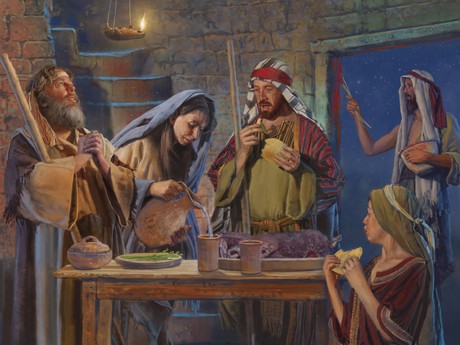
The head of the Israelite family was asked to set apart a blemish-less lamb on the 10th day of the first month. The lamb was to be killed in the evening of the 14th day Blood of the lamb must be put on the two side posts and on the upper door post of the house. Its flesh, roasted in fire must be eaten that night together with unleavened bread and bitter herbs. The bones of the lamb should not be broken. It must be eaten in haste, with their loins girded, shoes on their feet and staff in their hand signifying readiness to start their journey.

The first Passover was thus observed in Egypt. The angle of destruction came down that night and killed all the firstborns of Egypt. The sign of blood on the door posts of Israel saved them from destruction. The Egyptians compelled Israel to leave Egypt that night. A large group of people numbering six hundred thousand of men and their women and children set out on foot from Egypt. 

Yearly Observance:


Israel were commanded to observe the Passover feast every year on the 14th day of first month.

On the fourteenth day of the first month at twilight is the Lord's Passover.(Leviticus 23:5)

It can be seen from history that they continued to celebrate the feast as they were command. It was being celebrated even at the time of our Lord Jesus Christ. Christ was crucified during a Passover festival. 

Now the Passover of the Jews was at hand, and Jesus went up to Jerusalem. 14 And He found in the temple those who sold oxen and sheep and doves, and the moneychangers doing business. (John 2: 13, 14) 

Meaning of the word 'Passover': Leteral meaning of the word is : to pass over. 


For I will pass through the land of Egypt on that night, and will strike all the firstborn in the land of Egypt, both man and beast; and against all the gods of Egypt I will execute judgment: I am the Lord.(Exodus 12:23)

The name points to the night when the angle of destruction pass over the Israeli houses by seeing the sign of blood at he door posts.

SPIRITUAL TRUTHS AS REVEALED BY PASSOVER

1. Lamb of God: The chief objects in 'Passover' is the lamb. 


Image result for passover meal


The lamb foreshadows Jesus Christ.

Therefore purge out the old leaven, that you may be a new lump, since you truly are unleavened. For indeed Christ, our Passover, was sacrificed for us.(1 Corinthians 5: 7)

Christ is called Lamb in the scripture. The lamb is set apart four days before the Passover. Our Lord Jesus Christ was set apart as the Lamb of God before the foundation of the world. In the fullness of time the was crucified.

All who dwell on the earth will worship him, whose names have not been written in the Book of Life of the Lamb slain from the foundation of the world.(Revelation 13:8)


Just as the Passover lamb was burned in fire, Christ suffered in the fire of the wrath of God. The command the bones of the Lamb should not be broken was also fulfilled in Jesus Christ. His legs were not broken although the legs of the other two on the cross were broken. " Even Christ out Passover Lamb is sacrificed for us" Thus we are delivered from death which is the wages of out sin and from the bondage of Satan.


2. The Liberated Israel : People of Israel who were delivered from the bondage of Egypt be the blood of the Passover Lamb stand for New Testament believers. Our salvation is only through the blood of Jesus Christ. There is no condemnation for those who believe in him. Just as Passover marked the beginning of the year of Israel, faith in the sacrificial death of Jesus Christ opens a new chapter in out lives. Putting blood at the door posts shows that we are taking refuge in Him be faith. Eating of the roasted meat points towards the need to know Christ deeply and experience Him on our lives. It also signifies the participation of God's people in the Lord's Table. Believers must grow in strength through the partaking of Christ.

3. Unleavened Bread: Leaven represents uncleanness. Believers must keep holiness in life and doctrines. God commands: Do not touch any unclean things.


4. Bitter herb: when we are part of Christ, there will be experiences of bitterness and sorrows in this world. Jesus warned His disciples: " In the world you shall have Tribulation: but be of good cheer" (John 16:30). Apostles exhorted delivers we must go through much tribulation enter into the kingdom of God.


 strengthening the souls of the disciples, exhorting them to continue in the faith, and saying, "We must through many tribulations enter the kingdom of God." (Acts 14:22)

5. Eating the Passover meal in haste with loins girded, shoes on feet and staff on hand: believers must be ready to do service as per the example shown by our Lord. Our feet must have the preparation for the Gospel, of peace. Like Abraham we must consider out selves as strangers and pilgrims looking for the heavenly city. Let us always remember that we are journeying from this land of destruction to the city of Zion.

6. The Passover meal should not be eaten by a stranger: Only the saved ones have fellowship with God and His Church.

Are you saved by the blood of the Lamb of God? Do you have constant fellowship with Jesus Christ and the Church of God?


Lesson 11

FESTIVALS OF JEHOVAH 

Related image

Reading: Lev 23

Memory verses: 2 Cor. 2: 14, Pas. 118:15

Theme: To celebrate the victory and joy of life in Jesus Christ

Introduction: Is Christian life joyful or sorrowful? What is your personal opinion? Do the people whom you know praise God and rejoice in all circumstances of their life? Paul and Silas sang praises to God in the prison of Philippi

 But at midnight Paul and Silas were praying and singing hymns to God, and the prisoners were listening to them.(Acts 16:25)


Paul asks the Philippians to rejoice in the Lord always when the writes to them from the prison of Rome.

Rejoice in the Lord always. Again I will say, rejoice! (Phil 4:4)

The voice of rejoicing and victory will be in the tabernacles of God's people. Festivals if Israel are shadows of this truth. As these are given to Israel by God Himself the festivals are called the Festivals of Jehovah.

REASONS FOR GIVING THE FESTIVALS OF ISRAEL


1. It was the will of God that people who were delivered from Egypt should enjoy not only peace and rest but also happiness and joy in their life.

 You shall rejoice before the Lord your God, you and your son and your daughter, your male servant and your female servant, the Levite who is within your gates, the stranger and the fatherless and the widow who are among you, at the place where the Lord your God chooses to make His name abide. 12 And you shall remember that you were a slave in Egypt, and you shall be careful to observe these statutes. (Deuteronomy 16:11,12)

But their joy should be in the presence of God. Therefore, festivals were instituted by God to give them spiritual, happiness and sustain them in that happiness. New Testament believers also must rejoice in the Lord always.

2. It was the practice in Israel to hear the Word of God during the festival. People gathered together on the first day of the seventh month at the time of Nehemiah. Ezra stood up on a platform and read the law to the people from morning till noon. They rejoiced hearing the Law. It is an experience of joy to read, hear and meditate on the word of God.

Related image

 Now all the people gathered together as one man in the open square that was in front of the Water Gate; and they told Ezra the scribe to bring the Book of the Law of Moses, which the Lord had commanded Israel. 2 So Ezra the priest brought the Law before the assembly of men and women and all who could hear with understanding on the first day of the seventh month. 3 Then he read from it in the open square that was in front of the Water Gate from morning until midday, before the men and women and those who could understand; and the ears of all the people were attentive to the Book of the Law. 4 So Ezra the scribe stood on a platform of wood which they had made for the purpose; and beside him, at his right hand, stood Mattithiah, Shema, Anaiah, Urijah, Hilkiah, and Maaseiah; and at his left hand Pedaiah, Mishael, Malchijah, Hashum, Hashbadana, Zechariah, and Meshullam. 5 And Ezra opened the book in the sight of all the people, for he was standing above all the people; and when he opened it, all the people stood up. 6 And Ezra blessed the Lord, the great God. Then all the people answered, "Amen, Amen!" while lifting up their hands. And they bowed their heads and worshiped the Lord with their faces to the ground. 7 Also Jeshua, Bani, Sherebiah, Jamin, Akkub, Shabbethai, Hodijah, Maaseiah, Kelita, Azariah, Jozabad, Hanan, Pelaiah, and the Levites, helped the people to understand the Law; and the people stood in their place. 8 So they read distinctly from the book, in the Law of God; and they gave the sense, and helped them to understand the reading. (Nehamaiah 8:1-12)


3. Gathering of people from different places at one location during the festivals was providing opportunities to know each other and enjoy loving fellowship. In those days when communications were difficult, festivals helped people to remain as nation. Believers should endeavor to help each other and be in fellowship. Forget not to do good and to communicate.

But do not forget to do good and to share, for with such sacrifices God is well pleased.(Hebrew 13:6)

4. Festivals served as a reminder to other nations about the strength of Israel and prevented attack on them. Enemies of the gospel will be afraid if believers stand together. The Lord wants His people to be perfect in unity.

Now I am no longer in the world, but these are in the world, and I come to You. Holy Father, keep through Your name those whom You have given Me, that they may be one as We are. (John 17:11)


5. Festivals were occasions for people to bring their tithes offerings and voluntary donations to the Temple of God. New Testament believers are duty bound to give bountifully for Lord's work from their material blessings.

But this I say: He who sows sparingly will also reap sparingly, and he who sows bountifully will also reap bountifully. 7 So let each one give as he purposes in his heart, not grudgingly or of necessity; for God loves a cheerful giver.( 2. Cor.9:6,7)


6. Festivals of Israel prevented them from observing festivals of the heathen. They were commanded to observe separation and holiness as God's special people. Believers must keep themselves separated from heathen festivals and find joy in the presence of God along with other believers.

7. Festivals contained great prophetic meanings. They foreshadowed Christ's death and resurrection. His second coming, the millennium etc. In the New Testament age, we have to experience the substance of the festivals. How foolish it will be if we still run after the shadow!

Hebrew months: Days were allotted for the celebration of the festivals. The month in which they were liberated from Egypt was the first month in their calendar. Let us learn the Hebrew months in their order.


1. Abib (Nisan)  - Esther 3:7

2. Ziv   - 1 king 6:1

3. Sivan  - Esther 8:9

4. Thammuz - Ezekiel 8:14

5. Ab   - Ezra 7:9

6. Elul -  Nehemiah 6:15

7. Ethanim  (Tissri) - 1 king 8:2

8.Bul (Marchesvan) -  1 King 6:38


9. Chislev - Zachariah 7:1

10. Tebeth -  Esther 2:16

11. Shebath - Zachariah 1:7

12. Adar - Esther 8:11


Seven festivals God had given Israel seven festivals. All males in Israel were commanded to gather together in the presence of God on three seasons of the year and celebrate the festivals.


 "Three times you shall keep a feast to Me in the year 15 You shall keep the Feast of Unleavened Bread (you shall eat unleavened bread seven days, as I commanded you, at the time appointed in the month of Abib, for in it you came out of Egypt; none shall appear before Me empty); 16 and the Feast of Harvest, the firstfruits of your labors which you have sown in the field; and the Feast of Ingathering at the end of the year, when you have gathered in the fruit of your labors from the field. 17 Three times in the year all your males shall appear before the Lord God.(Exodus 23: 14 -17)


1. Passover                             : Month 1 Day 14

2. Unleavened bread              : Month 1 Day 15 - 21

3. First fruits                          : Month 1 Day 16

4. Pentecost (feast of weeks) : Month 3 Day 6

5. Trumpets                           : Month 7  Day 1

6. Atonement                         : Month 7 Day 10

7. Tabernacles                        : Month 7 Day 15 - 22   


The three festivals in the first month are referred to as Passover feast or the fest of the unleavened bread. As the fourth festival falls on the fiftieth day after the festival of the first fruits, it is known as the feast of Pentecost or the festival of the weeks. The three festivals falling in the seventh month are together known as the fest of the tabernacles.

OTHER FESTIVALS OF ISRAEL

Two more festivals were added in Israelite calendar later on.

1. Feast of the dedication :

 Now it was the Feast of Dedication in Jerusalem, and it was winter. (John 10:22)

Antiochus Ephiphanus, the Syrian king desecrated the Temple of Jerusalem by sacrificing a pig in it. Temple was reclaimed by Maccabees and dedicated once again. To commemorate this event, Israel started to observe on the feast of dedication on the 25th day to the 8th month from B.C 164. On that day Jewish homes would be illuminated and the heroic deeds of the Maccabees would be narrated to their children.


2. Festival of Purim:

And Mordecai wrote these things and sent letters to all the Jews, near and far, who were in all the provinces of King Ahasuerus, 21 to establish among them that they should celebrate yearly the fourteenth and fifteenth days of the month of Adar, 22 as the days on which the Jews had rest from their enemies, as the month which was turned from sorrow to joy for them, and from mourning to a holiday; that they should make them days of feasting and joy, of sending presents to one another and gifts to the poor. 23 So the Jews accepted the custom which they had begun, as Mordecai had written to them, 24 because Haman, the son of Hammedatha the Agagite, the enemy of all the Jews, had plotted against the Jews to annihilate them, and had cast Pur (that is, the lot), to consume them and destroy them; 25 but when Esther came before the king, he commanded by letter that this wicked plot which Haman had devised against the Jews should return on his own head, and that he and his sons should be hanged on the gallows. 26 So they called these days Purim, after the name Pur. Therefore, because of all the words of this letter, what they had seen concerning this matter, and what had happened to them, (Esther 9:20-25)


When Haman, the minister of king Ahasuerus plotted to annihilate the Jewish race, they were saved miraculously by God's providence. Thus Purim was declared as days of joy and victory on 14th and 15th Adar (12th month). This festival which was instituted in the 5th century BC is being celebrated as the Jewish national day. Purim means 'lot'. The day which was selected by Haman through casting lots to destroy Israel turned out to be their day of celebration.

All festivals of Israel were days of joy which teach us many spiritual truths. Praise God for the joy that we enjoy through Jesus Christ. 


Saturday, November 17, 2018

Lesson 10

TRESPASS OFFERING 


Reading: Lev. 5: 1-16, 7:1-10
Memory verses : Micah 7: 18,19

Theme: These is remission in Christ for all our sins not only those inherited by birth but also trespasses committed individually. Let us, therefore, experience the joy of forgiveness of all-out sins in our lives. 

Introduction: We are currently studying the details about sacrifices. How many important sacrifices are there? Which are the sweet savour offering and which are the not-sweet savour offering? The first type of sacrifices shows that Christ became in the sight of God and the second type show what He became for us. We identify ourselves with Christ in the sweet savour offering while Christ identifies Himself with us in the nonsweet savour offerings. Sin offering teaches us that we are sinners by birth and the remission of our sins can be obtained through the sacrifice of Jesus Christ. Trespass offering shows that there is remission through Christ for the trespasses committed by us individually. 


TRESPASSES 


Sin is the nature that man has acquired by birth. Trespasses are those transgressions of the law which man commits individually in his life. Trespasses are those deeds which go outside the boundaries of the law. There are two types of trespasses:

1) Those against  God 

2) Those against man 

Look at the ten commandments given by God through Moses. The first four of those are concerned with man's relationship with God. The other six are concerned with man's relationship with the man. The breaking of these laws constitutes trespasses. Trespass offering is instituted to obtain remission of these transgressions. Through the death of Christ on the cross, a believer obtains forgiveness for his sin and sins. We have redemption through His blood, the forgiveness of sins


Sacrificial objects: The worshiper was permitted to offer any one of the following objects according to his ability as a trespass offering:

1. A female goat or lamp
2. Two turtle doves or two young pigeons
3. Tenth part of an ephah of fine flour
4. A ram if the trespass os against the holy things of the Lord


Method of offering: The method was the same as that of a sin offering. The worshiper brings the animal at the entrance to the tabernacle, places his hand upon its head and kills it. The priest takes some of its blood and sprinkles it round about the altar. The remaining blood is poured out at the foot of the altar. The fat, the kidneys and the caul are burnt on the altar. Priests eat the remaining portions of the flesh inside the court of the tabernacle. If the offering consists of turtledoves or pigeons, priest wrings off the head of one of them, sprinkles some of its blood on the altar and the rest poured at the foot of the altar. The other dove is offered as a burnt offering on the altar. It the offering is fine flour, no oil or frankincense is added. A priest takes a handful of the flour and burns it on the altar. The remaining flour is like a meal offering for the priest. If the offering is a ram, priest sacrifices it as a trespass offering.

The different articles for the offering signify different aspects of the divine nature of Jesus Christ. What do goat, sheep, dove and fine flour shows? Jesus Christ suffered silently to bring forgiveness for our sins and trespasses


 He was oppressed and afflicted, yet he did not open his mouth; he was led like a lamb to the slaughter, and as a sheep before its shearers is silent, so he did not open his mouth. (Isaiah 53:7)

Christ redeemed us from the curse of the law by becoming a curse for us, for it is written: “Cursed is everyone who is hung on a pole.”  (Galatians. 3:13)


Jesus was born poor and suffered sorrows and presented His unblemished life to His Father. Let us praise God for the great salvation that we have received through His death on the cross.


Compensation: If the trespass offering is in connection with the holy things of God or with the property of a friend, the guilty person has to pay compensation for the cost and fifth more. This is a speciality of trespass offering. There are two spiritual meanings underlying the compensation clause;

1). Christ's death has restored all the losses of mankind completely. The glory that is in store for the redeemed children of God is much more than the glory that Adam had before his fall. God has saved us by the gospel to give the glory if Jesus Christ.

2). A man who repents and is saved must compensate for the trespasses that he committed against God and men earlier seek pardon from those whom he wronged; return properties wrongly acquired; be reconciled with people where reconciliation is needed. When Zacchaeus came into contact with Jesus, see what happened in this life.

But Zacchaeus stood up and said to the Lord, “Look, Lord! Here and now I give half of my possessions to the poor, and if I have cheated anybody out of anything, I will pay back four times the amount.”  (Luke 19:8)


Saturday, October 20, 2018

Lesson 9

SIN OFFERING

Reading: Lev. 4, 6:24-30
Memory verse: 1 Pet. 2:24

Theme: To lead a holy life after obtaining remission of sins by faith in Jesus Christ who became a sacrifice on the cross bearing sins of all mankind.

Introduction: What is it that keeps a man away from fellowship with God? How did sin enter into the world? What happened to mankind by the disobedience of Adam and Eve? Jesus Christ came to this world as a man and took upon Himself the punishment for our sins and suffered death on the cross. Sin offering was instituted for Isreal as a shadow of Christ's sacrifice. Christ was made sin for us.

God made him who had no sin to be sin for us, so that in him we might become the righteousness of God. (2 Corinthians 5:21)

Sin offering is one of the two non-sweet savour offerings. A person was required to offer sin offering at first when he comes to the presence of God. 

PEOPLE WHO WERE REQUIRED TO OFFER SIN OFFERING 

Four types of people were commanded to offer sin offering. 

1) Priest
2) Congregation of Isreal 
3) Elders of the people 
4) Ordinary Israelite


All people are covered by these four groups. It proclaims the truth that all have sinned and come short of the glory of God.

 for all have sinned and fall short of the glory of God. (Romans 3:14)

As all are sinners every one needs remission of sins. Even by birth, man is a sinner and with the nature of sin. Every sin committed, whether inadvertently or not needs remission.

SACRIFICIAL ANIMALS AND METHOD OF OFFERING 

People belonging to the above four groups were commanded to offer sacrifices differently. The differences point to different aspects of the death of our Lord.

1. Sacrificial animals to be offered by the priest and congregation of Isreal were of the same type. The animal was young bull if the offering is for himself and the elders of Isreal would do the same if it is for the whole congregation. The animal is, then killed. The priest takes some blood of the animal, enters the Holy Place in the tabernacle, sprinkled it before the veil seven times and smears it on the horns of the altar of incense. The remaining blood is poured at the foot of the altar of burnt offering. Fat, kidneys and covering the liver are burnt on the altar of burnt offering. All the remaining portions of the animal are taken outside the camp to a clean place meant for dumpling ash and then burnt on a wood fire. 

Christ who came down in the form of servant took out sins and became a sin offering of Calvary. The sprinkling of blood in front of the veil signifies that we can enter into the presence of God.

 But when Christ came as high priest of the good things that are now already here, he went through the greater and more perfect tabernacle that is not made with human hands, that is to say, is not a part of this creation. He did not enter by means of the blood of goats and calves; but he entered the Most Holy Place once for all by his own blood, thus obtaining eternal redemption. The blood of goats and bulls and the ashes of a heifer sprinkled on those who are ceremonially unclean sanctify them so that they are outwardly clean.  How much more, then, will the blood of Christ, who through the eternal Spirit offered himself unblemished to God, cleanse our consciences from acts that lead to death, so that we may serve the living God! (Romans 9:11-14)


The smearing of blood on the horn of the altar of incense points to the privilege that has come to us for worshipping God. IT also signifies the intercessory prayer of Christ. Pouring of blood at the foot of the altar shows reconciliation that we have received individually with God. All the remaining portions of the animal are burnt outside the camp of Isreal. It points to the suffering the Christ had to undergo outside Jerusalem. We must also be prepared to bear His reproach and suffer outside the camp.

2. Sacrifices of elders and ordinary Israelite: An elder offers a male goat and an ordinary Israelite offers either a female goad or a female lamb. The procedure for the offering was the same in both cases. The worshiper places his hand upon the head of the animal and kills it at the entrance to the tabernacle. The priest dips his finger in the blood, smears the blood on the horns of the altar of burnt offering and pours the remaining blood at the foot of the altar. Blood is not taken inside the Holy Place. Fat and kidneys of the animal are burnt on the altar. The remaining flesh is cooked and eaten by the priests inside the court of the tabernacle. "All the males among the priests shall eat thereof: it is mot holy". This points to the fellowship of the children of God who are priests. Every child of God who has obtained remission of sins through the sacrifice of Jesus Christ most keep themselves continually in fellowship with God and His people. This fellowship also stands for the Lord's Table. 

Have you received remission of your sins by accepting Jesus Christ as your Saviour? If so, the Lord requires you to suffer for Him outside the camp, leaving all worldly pleasures. Are you prepared for it? Are you keeping in constant fellowship with God and His children?